
Denver County Probate Records
Denver Probate Court is a separate Colorado Judicial Branch court at 1437 Bannock Street, Room 230, Denver, CO 80202. Presiding Judge Elizabeth D. Leith is appointed by the Governor, and Magistrate Beth A. Tomerlin is hired by the Presiding Judge. The clerk's office phone is 303-606-2303, and the clerk email is 02DPCClerksOffice@judicial.state.co.us.
Denver County probate records include decedent estates, wills, personal representatives, guardianships, conservatorships, restricted registry-account petitions, family tree forms, and probate orders. Access is through Denver Probate Court, not Denver County Court. Pro se filings are not accepted by fax or email; unrepresented parties may file in person or by mail to Room 230.
The official court source for this page is the Denver Probate Court page.
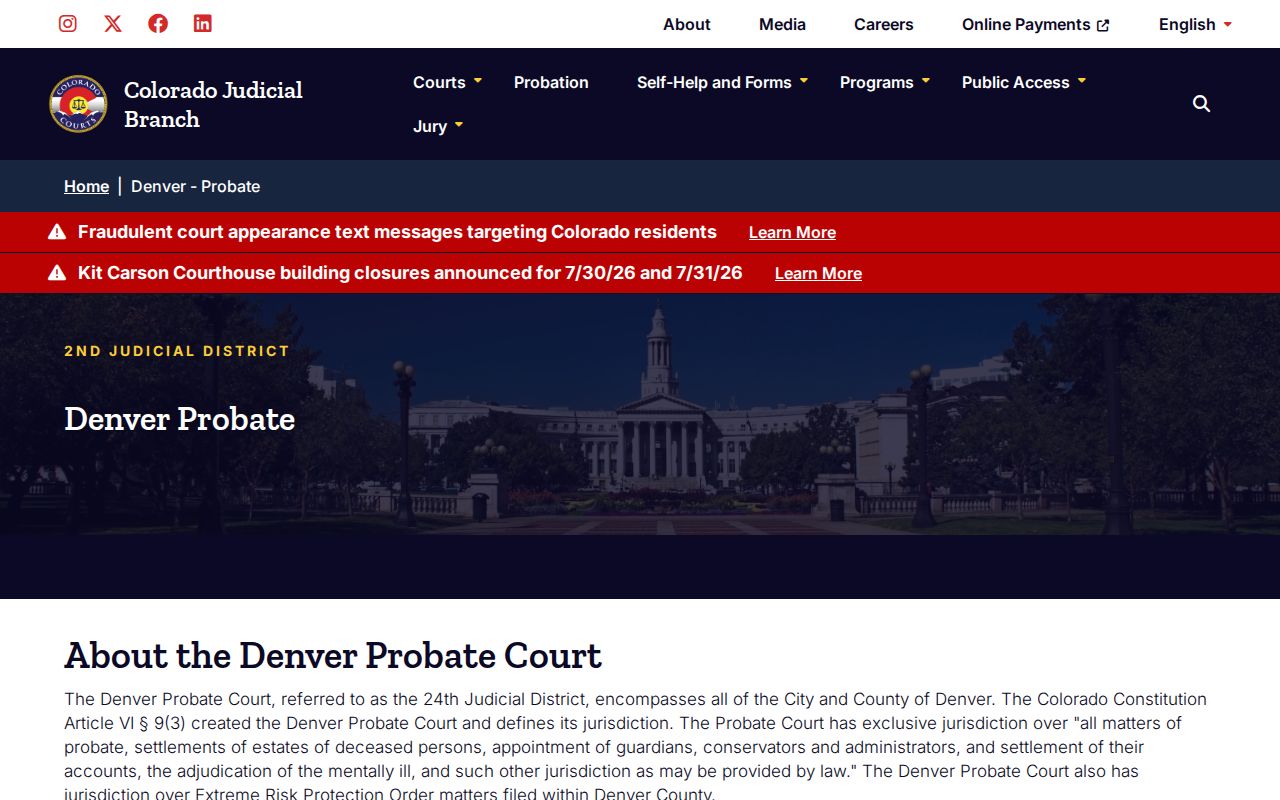
That source provides the Room 230 contact, record request channels, self-help details, and court-specific filing notes.
Denver Probate Terms Defined
Probate records often use terms that do not appear in ordinary civil or criminal files. These definitions help connect a Denver Probate Court record to the person, estate, or protected person named in the filing.
- Testator
- A person who made a will.
- Executor
- A person named to carry out a will. Colorado records may also use personal representative.
- Intestate
- A person died without a will, so estate handling follows legal succession rules.
- Guardianship
- A case about personal-care decisions for a protected person.
- Conservatorship
- A case about management of a protected person's estate or financial affairs.
- Exemplification
- A more formal authenticated copy than a standard certification.
Search Denver Probate Records
Denver Probate Court accepts records and search requests in person, by phone, by mail, by email to DenverProbateRecordsRequest@judicial.state.co.us, and through the online portal linked from the probate page. A case number is the best search key. If the case number is unknown, the court charges a name-search fee. Older probate research should account for the statewide index limit.
- Start with the case number if it is known, or collect the party name and case type.
- For estate matters, add date of death, county of residence, and the specific documents needed.
- Submit the request to Room 230, by phone, by mail, by email, or through the linked online portal.
- Approve search, copy, certification, exemplification, retrieval, or postage fees when they apply.
- For pre-1988 index issues, contact the county where the probate matter was filed.
The statewide index does not go further back than 1988. For records filed in counties other than Denver before 1988, the request should go to the county where the case was filed. That limit matters for older estates, old guardianships, and family history searches where the filing county is not certain.
Denver Probate Request Fields
A complete request helps the clerk locate the file and estimate costs. Denver Probate Court's request guidance names several fields that should be included where applicable. Use exact names and dates when possible, and specify whether the request is for letters, orders, wills, inventories, filings, or a full file review.
| Field / Item | Type | Required | Notes |
|---|---|---|---|
| Case number(s) | Text | If known | Include to avoid a $5 name search. |
| Party's name | Text | Where applicable | Used for search. |
| Date of death | Date | Where applicable | Important for estate matters. |
| Date of birth | Date | Where applicable | Useful in guardianship and conservatorship searches. |
| County of residence | Text | Where applicable | Helps determine venue and older-record location. |
| Documents requested | Text/list | Yes | Specify letters, orders, will, inventory, filings, or other needed records. |
Denver Probate Court Contact
Denver Probate Court is in the City and County Building, the same civic building used for Denver District civil and domestic matters. The probate page gives a precise navigation note: after stepping off the elevator on the second floor, turn left, and the clerk's office is at the end of the hall on the right. The self-help center is nearby but uses a separate phone and email.
Denver Probate Court
1437 Bannock Street, Room 230
Denver, CO 80202
303-606-2303
02DPCClerksOffice@judicial.state.co.us
Denver Probate Court is the probate custodian for Denver County. Marriage records are with the Clerk and Recorder, while divorce files are with District Court. When a family record search crosses from estate papers into a divorce decree or marriage license, use the correct custodian rather than sending all requests to Room 230.
Denver Probate Fee Schedule
Denver Probate Court publishes record-search and copy charges for common probate requests. Filing fees for new cases may depend on case type and the statewide fee schedule, but the record-copy schedule below is the key list for searchers requesting existing files or certified copies.
| Fee | Amount |
|---|---|
| Search request or name search | $5 per name, upfront if no case number |
| Copy | $0.25 per page |
| Certification | $20 each |
| Exemplification | $20 each |
| Offsite record retrieval | $15 per case |
| Postage | $1 for 10 pages |
The statewide fee source in the manifest is the Colorado Judicial Branch list of fees.
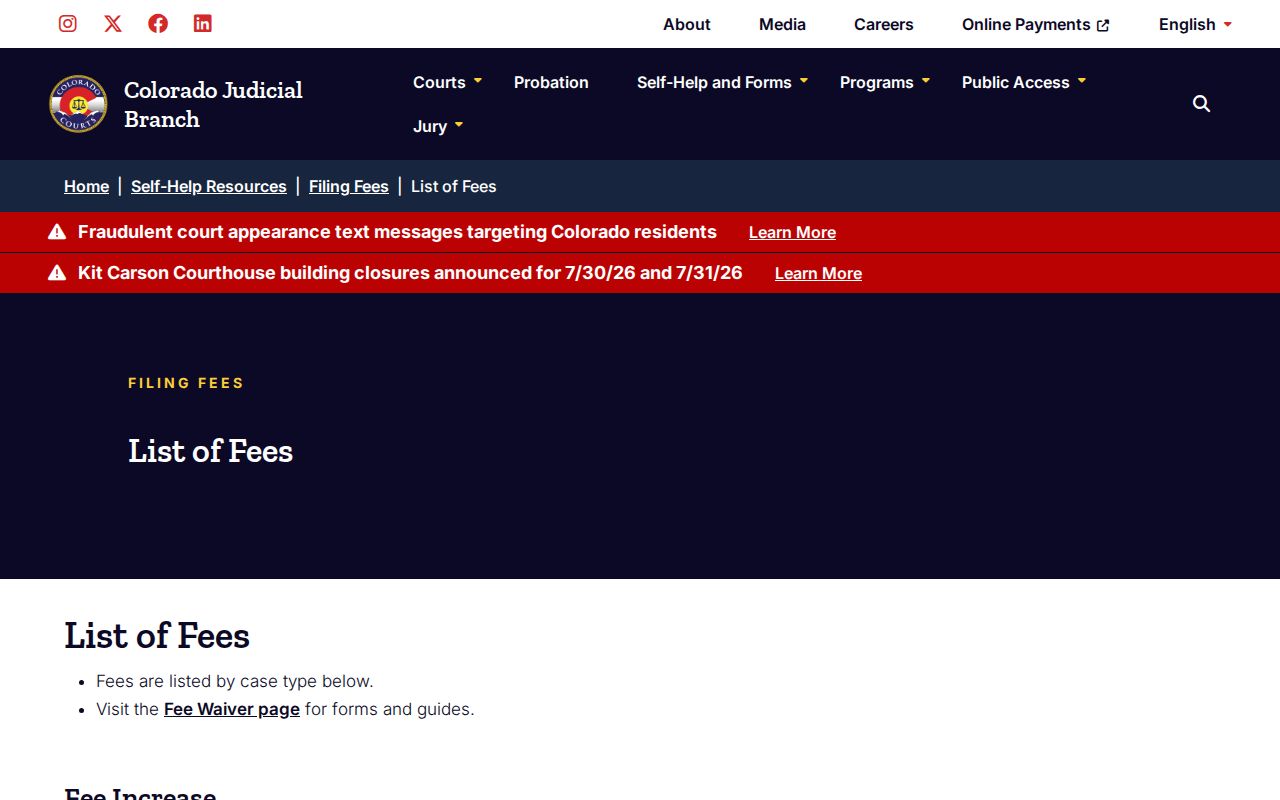
The fee list supports cost checks when a probate request involves copies, authentication, or retrieval beyond a simple file lookup.
Denver Probate Self Help
The Denver Probate Self-Help Center gives procedural and general probate information to unrepresented parties in Room 230, by phone at 303-606-2502, and by email at DPCSelfHelp@judicial.state.co.us. The self-help line is separate from the clerk's office line. It can explain process and forms, but it does not act as a lawyer for a party.
Forms for initiating probate cases are generally not Denver-specific and are found in the Colorado Judicial Branch forms library. Denver-specific forms listed in the research include DPC 5 Petition to Withdraw Funds from Restricted Registry Account, DPC 6 Objection to Magistrate Hearing Case, and DPC 8 Decedent's Family Tree. These forms are useful clues when a search involves restricted funds, magistrate review, or estate-family relationships.
The manifest source for form access is the Colorado Judicial Branch self-help forms library.
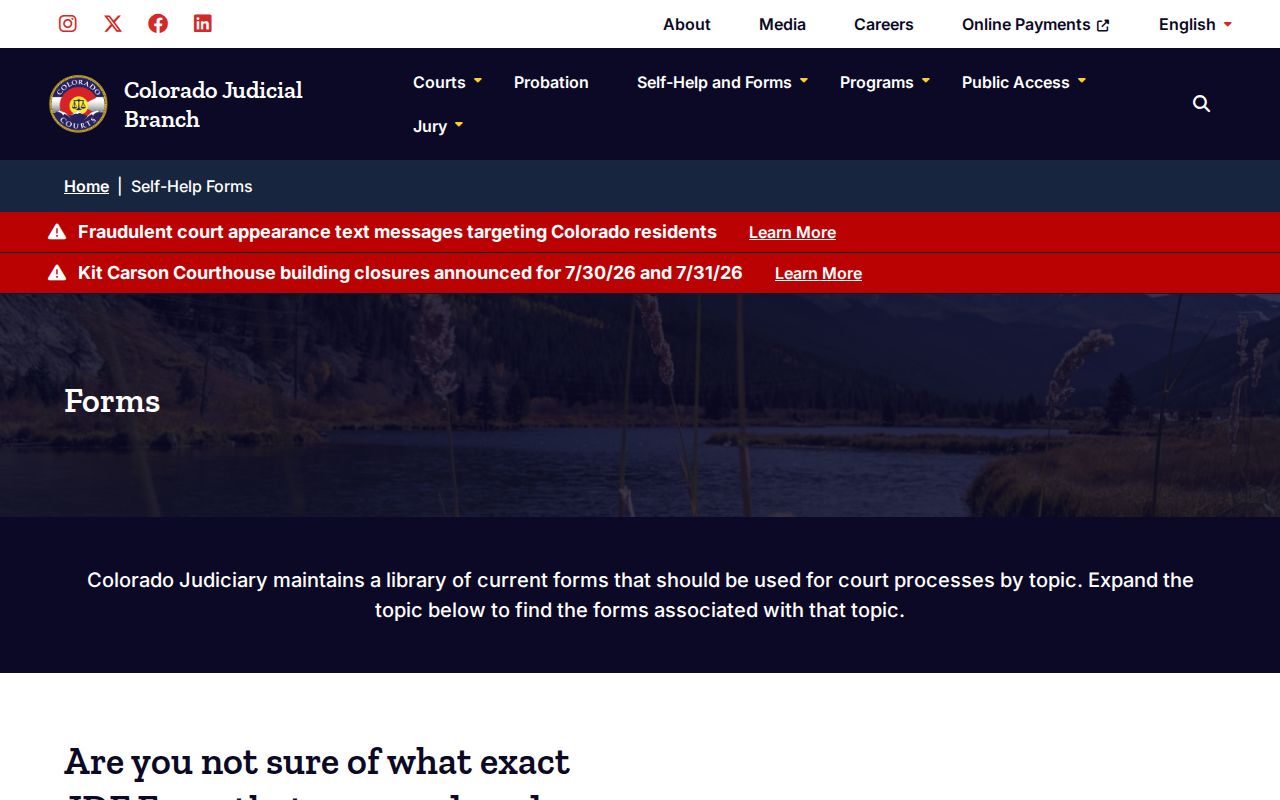
State forms and Denver-specific probate forms help distinguish a records request from a new case filing.
Denver Estate and Will Records
Denver County probate records can show a decedent estate, will, letters appointing a personal representative, inventories, accountings, orders, restricted registry account filings, and closing documents. Guardianship and conservatorship records can show petitions, appointments, reports, and orders tied to a protected person. Some material may be restricted because it concerns minors, protected persons, finances, medical issues, or sealed filings.
A probate record should be read by case type. A will filing does not always mean a contested estate. A guardianship does not always include control over money. A conservatorship is focused on estate or financial management, while a guardianship concerns personal-care decisions. The case number, caption, orders, and letters usually show which authority the court granted.
Restricted Denver Probate Records
Probate records are court records, but not every filing is open in full. Colorado access rules protect confidential information, and probate files may include financial accounts, medical facts, minor information, protected-person details, or sealed filings. A public index or docket may confirm that a case exists while the clerk withholds or redacts sensitive documents.
For confidential or older matters, the safest route is to identify the case type, gather the party name and date details, and ask the Denver Probate Court clerk what can be released. The signed order, letters, or certified copy from the clerk is stronger than a screenshot or informal index entry when a bank, title company, agency, or out-of-state court asks for proof.
Note: The statewide index limit before 1988 is a search boundary, not proof that an older Denver County probate record does not exist.